


Canada has introduced major immigration reforms in 2026 to better manage population growth and reduce pressure on housing, healthcare, education, and infrastructure. While the country remains committed to welcoming skilled workers, students, entrepreneurs, and families, the immigration system is now more selective and strategically focused.
The most significant changes include a reduction in permanent resident admissions to 380,000, stricter limits on international students and temporary foreign workers, updated income requirements for the Parent and Grandparent Super Visa, and important citizenship reforms under Bill C-3.
If you are planning to move to Canada, understanding these changes is essential for choosing the right immigration pathway and preparing a competitive application.
Why Canada Changed Its Immigration Policies in 2026
In recent years, Canada experienced rapid population growth driven by high levels of permanent and temporary immigration. Although immigration remains critical to economic development, this growth increased demand for:
- Housing and rental accommodation
- Healthcare services
- Schools and colleges
- Transportation infrastructure
- Public services
To ensure sustainable growth, the government adopted a more balanced immigration approach that aligns admissions with the country’s capacity to support newcomers successfully.
Key Canada Immigration Changes in 2026
| Update | What It Means |
|---|---|
| Permanent Resident Target Reduced | Canada plans to admit approximately 380,000 new permanent residents in 2026 |
| Temporary Resident Reduction | Goal to reduce temporary residents to below 5% of Canada’s population |
| International Student Caps | Provincial limits continue to restrict new study permits |
| Temporary Foreign Worker Restrictions | Tighter employer compliance and reduced access in some sectors |
| Super Visa Income Changes | Sponsors must meet updated financial thresholds |
| Bill C-3 Citizenship Reform | Expanded citizenship by descent and restoration of citizenship in certain cases |
| Stronger Economic Focus | Priority given to skilled workers and labour market needs |
Permanent Resident Target Reduced to 380,000
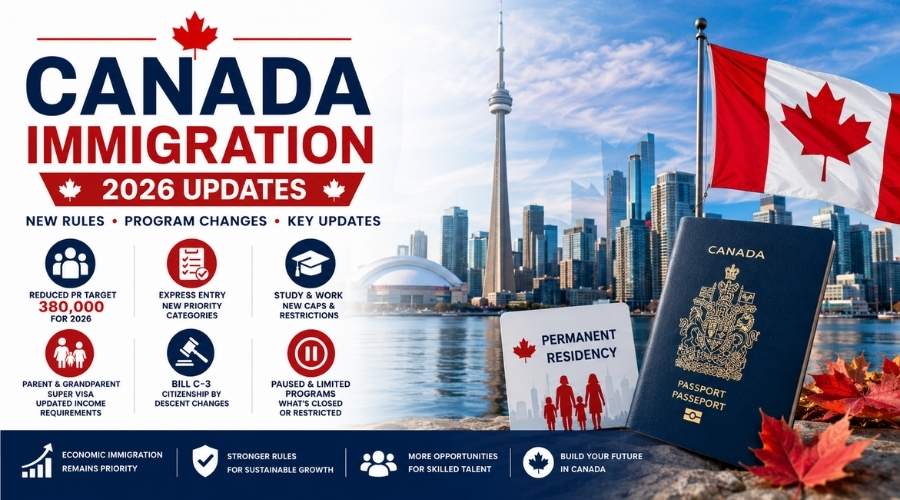
One of the most important immigration updates for 2026 is the reduction of Canada’s permanent resident admissions target to approximately 380,000.
This lower target reflects the government’s intention to balance immigration with housing availability, infrastructure, and public services. Although admissions are reduced, Canada continues to prioritize economic immigration and family reunification.
Express Entry 2026: Priority Categories and New Trends
Express Entry remains Canada’s primary system for selecting skilled workers for permanent residence.
In 2026, invitations are increasingly targeted toward applicants with skills in high-demand sectors.
Priority Occupation Categories
| Category | Examples |
|---|---|
| Healthcare and Social Services | Nurses, physicians, caregivers, therapists |
| Skilled Trades | Electricians, plumbers, welders, carpenters |
| Education | Teachers and early childhood educators |
| Transportation | Truck drivers and transport specialists |
| French-Language Proficiency | Candidates with strong French skills |
| Research and Advanced Talent | Researchers and senior professionals |
| Foreign Medical Doctors | Doctors with Canadian work experience |
Applicants in these categories may receive invitations even with lower CRS scores than in general draws.
Provincial Nominee Program (PNP): One of the Best Pathways
The Provincial Nominee Program remains one of the strongest options for immigration to Canada.
Each province selects candidates whose skills match local labour shortages. A nomination through an Express Entry-linked stream adds 600 CRS points, effectively guaranteeing an invitation to apply for permanent residence.
Popular Provinces for Immigration
- Ontario
- British Columbia
- Alberta
- Saskatchewan
- Manitoba
- Nova Scotia
Temporary Residents to Be Reduced Below 5% of Population
Canada aims to reduce the total number of temporary residents—including international students and temporary foreign workers—to below 5% of the national population.
This policy has major implications for:
- Study permits
- Work permits
- Open work permits for family members
- Employer-sponsored LMIA applications
Applicants should expect more selective approvals and greater scrutiny of documentation.
International Student Policy Changes in 2026
International students continue to have opportunities in Canada, but admission has become more competitive.
| Change | Impact |
|---|---|
| Provincial Study Permit Caps | Limits the number of new approvals |
| Stricter Financial Requirements | Greater proof of funds may be required |
| Increased Institutional Oversight | Focus on approved institutions with strong outcomes |
| Family Work Permit Restrictions | Reduced eligibility for some spouses |
Students should choose programs aligned with labour market needs to maximize future immigration opportunities.
Temporary Foreign Worker Program Restrictions
Canada has introduced stricter rules for employers using the Temporary Foreign Worker Program.
Key Changes
- More employer inspections
- Reduced use of low-wage foreign labour in some sectors
- Stronger LMIA requirements
- Greater focus on occupations facing genuine shortages
Workers in healthcare, construction, agriculture, and skilled trades continue to enjoy strong demand.
Parent and Grandparent Super Visa Income Updates
The Super Visa remains an important option for bringing parents and grandparents to Canada for extended visits.
In 2026, sponsors must meet updated income thresholds based on family size. Proper financial planning is essential before submitting an application.
Bill C-3: Citizenship by Descent Changes
Bill C-3 introduces significant reforms to Canada’s citizenship laws.
Main Benefits
- Expands citizenship by descent beyond the first generation in certain cases
- Restores citizenship to some previously excluded individuals
- Allows transmission of citizenship if the Canadian parent accumulated sufficient physical presence in Canada
This legislation benefits many Canadian families living abroad.
Programs That Are Paused, Limited, or More Competitive
| Program | Current Status in 2026 |
|---|---|
| Parent and Grandparent Program (PGP) | Invitation-based and highly competitive |
| Some LMIA Work Permit Streams | More restrictive and closely monitored |
| International Student Admissions | Limited by provincial caps |
| Temporary Public Policies | Several previous policies have expired |
Best Immigration Pathways in 2026
| Applicant Type | Recommended Pathways |
|---|---|
| Skilled Professionals | Express Entry, Provincial Nominee Program |
| Temporary Workers in Canada | Canadian Experience Class, PNP |
| International Students | Study Permit → PGWP → Permanent Residence |
| Entrepreneurs | Start-Up Visa Program |
| Families | Spousal Sponsorship, Super Visa |
How to Improve Your Chances of Success
To remain competitive under Canada’s new immigration system, applicants should:
- Achieve high IELTS, CELPIP, or TEF scores
- Learn French to access additional selection categories
- Gain experience in priority occupations
- Secure a provincial nomination
- Obtain Canadian education or work experience
- Submit complete and accurate documentation
- Monitor program openings and apply promptly
Is Canada Still a Good Country for Immigration in 2026?
Yes. Canada remains one of the most transparent and immigrant-friendly countries in the world. Although the system is more selective, the country continues to offer excellent opportunities for skilled professionals, students, entrepreneurs, and families.
With strong preparation and a strategic approach, Canada still provides one of the best pathways to permanent residence, citizenship, and long-term success.
Final Thoughts
Canada Immigration in 2026 is more focused, more competitive, and more aligned with sustainable population growth. Reduced immigration targets, tighter controls on temporary residents, and new citizenship rules require applicants to be better prepared than ever.
The most promising pathways remain Express Entry, the Provincial Nominee Program, family sponsorship, and study-to-permanent-residence strategies.
If you understand the latest rules and build a strong profile, Canada continues to offer outstanding opportunities to live, work, and build a secure future.