
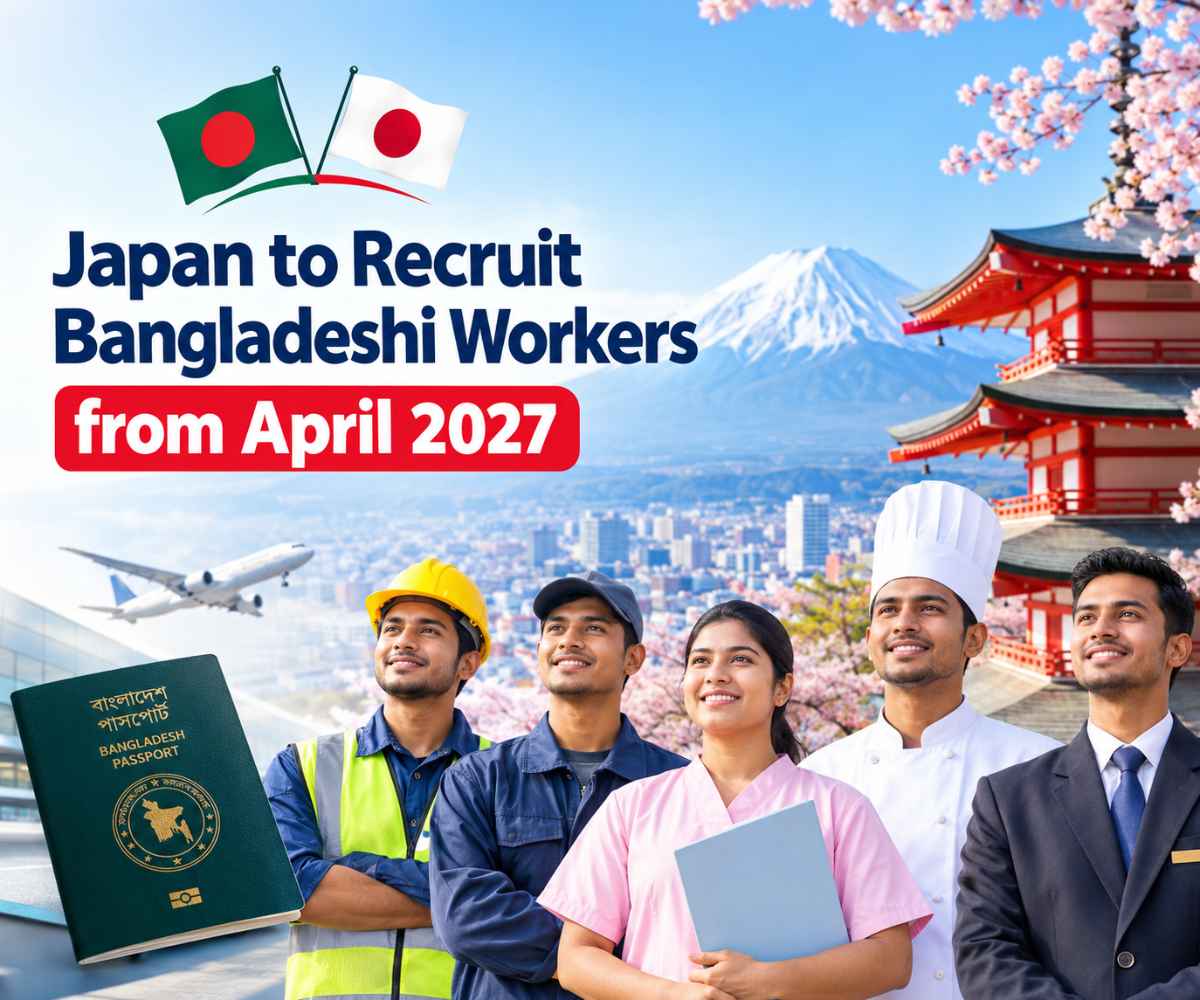
Japan is preparing to open another pathway for Bangladeshi workers through a new bilateral agreement on employment and skills development. Under the agreement signed on October 17, 2026, recruitment under the new arrangement is scheduled to begin on April 1, 2027.
The development could create new opportunities for people in Bangladesh who want to build careers overseas, gain international work experience and develop professional skills. It also places emphasis on worker protection, fair treatment and cooperation between the governments of Bangladesh and Japan.
However, prospective applicants should understand that the agreement does not automatically guarantee a job or a visa. Candidates will still need to meet the requirements of the relevant employment route, qualify for a suitable position and complete the required recruitment and immigration procedures.
In this guide, we explain what the new Bangladesh–Japan agreement means, who may benefit, how to prepare and what applicants should check before paying any recruitment fees.
1. What Is the New Bangladesh–Japan Employment Agreement?
Bangladesh and Japan signed the Memorandum of Cooperation on Employment Skills Development (ESDP-MOC) on October 17, 2026, following negotiations between the two countries.
According to reports based on information from Bangladesh’s Ministry of Expatriates’ Welfare and Overseas Employment, recruitment under the new arrangement is scheduled to start on April 1, 2027.
The agreement will initially remain in effect for five years, with automatic extension for another five years, making its potential total duration ten years.
The initiative aims to strengthen cooperation in recruiting workers, developing professional skills and improving protections for Bangladeshi nationals employed in Japan.
Key facts about the agreement
| Topic | Details |
|---|---|
| Participating countries | Bangladesh and Japan |
| Agreement | ESDP-MOC |
| Signing date | October 17, 2026 |
| Scheduled recruitment start | April 1, 2027 |
| Initial duration | Five years |
| Extension | Automatic extension for another five years |
| Main objectives | Employment opportunities, skills development and worker protection |
The agreement is an important development for overseas employment, but applicants should wait for official recruitment notices and detailed implementation instructions before making decisions about specific jobs.
2. What Job Opportunities Could Be Available in Japan?
Japan employs foreign workers across several industries, including manufacturing, construction, agriculture, food production, hospitality and caregiving. The positions available to Bangladeshi applicants will depend on employer demand, the relevant work-status category and the recruitment arrangements in effect.
Potential areas to explore include:
Manufacturing and industrial work: Factory operations, production processes, assembly and other eligible industrial occupations.
Construction: Building work, infrastructure-related occupations and other qualifying construction roles.
Agriculture: Crop production, farm operations and other eligible agricultural activities.
Food processing and food service: Food manufacturing, preparation and service roles that meet the applicable program requirements.
Caregiving: Eligible nursing-care positions for applicants who meet the relevant language, skills and training standards.
Hospitality: Certain hotel and accommodation-related positions, depending on the applicable work category.
These are examples of sectors in which Japan has established employment pathways for foreign nationals. They should not be interpreted as a confirmed list of vacancies under the new agreement. Actual occupations, recruitment numbers and eligibility conditions must be confirmed through official announcements and verified employers.
3. Who Can Apply for Jobs in Japan?
There is no single eligibility checklist that applies to every job in Japan. Requirements depend on the occupation, employer, work-status category and the rules in force when an application is submitted.
Nevertheless, prospective applicants should begin preparing the following:
- A valid passport and accurate personal information.
- Educational certificates relevant to the intended occupation.
- Evidence of professional experience, where required.
- Vocational training certificates or evidence of technical skills, if applicable.
- Japanese-language proficiency appropriate to the position.
- Any required occupational skills-test results.
- Medical and other supporting documents required for the relevant process.
- The ability to meet the employer’s employment conditions and Japan’s immigration requirements.
Some jobs may accept applicants with limited formal education but require practical skills or training. Other positions may require specific qualifications, relevant experience or more advanced language proficiency.
Important: Do not assume that all applicants must have the same education level, age, Japanese-language certificate or work experience. Verify the requirements for the exact position before enrolling in training or submitting an application.
4. Understanding Japan’s Existing Work Pathways
The new ESDP-MOC is an employment and skills-development cooperation agreement. It should not be confused with a new visa category unless the authorities formally announce such a category.
Japan already has established pathways for foreign workers. Two important examples are the Specified Skilled Worker (SSW) system and the Technical Intern Training framework.
Specified Skilled Worker (SSW)
Japan’s Specified Skilled Worker system allows eligible foreign nationals to work in designated industrial fields when they satisfy the relevant requirements.
For the SSW (i) category, applicants generally need to pass an occupational skills test and a recognized Japanese-language test. The usual language requirement is the Japan Foundation Test for Basic Japanese (JFT-Basic) or Japanese-Language Proficiency Test (JLPT) N4 or higher, with additional requirements for certain occupations.
Applicants who have satisfactorily completed qualifying Technical Intern Training may be exempt from some tests, subject to the applicable rules and occupation.
The SSW system covers designated fields, but not every job in Japan qualifies. Candidates should check the current official list of occupations and requirements before choosing a training programe.
Technical Intern Training
Japan’s Technical Intern Training framework has historically provided a pathway for foreign nationals to acquire occupational skills through structured training and work experience.
However, Japan has been developing a replacement framework known as the Employment for Skill Development system. Applicants should therefore verify the current transition arrangements and the rules applicable to their intended recruitment route instead of relying on outdated information about the former system.
Other professional work categories
Candidates with relevant university degrees, professional qualifications or specialized experience may also qualify for other Japanese work-status categories, depending on the nature of the job and the employer.
The appropriate route must be determined by the actual position and immigration rules, not simply by the applicant’s preference.
5. Do You Need to Learn Japanese Before Applying?
Learning Japanese can significantly improve your preparation for employment in Japan.
Language ability may be necessary for passing examinations, understanding workplace instructions, communicating with colleagues and managing daily life. The level required varies by occupation and work-status category.
If you plan to apply in 2027, consider starting with:
- Basic Japanese vocabulary and everyday conversations.
- Reading and recognizing hiragana and katakana.
- Essential workplace expressions and safety instructions.
- Listening and speaking practice.
- Preparation for the relevant Japanese-language examination, if required.
For many SSW (i) occupations, JFT-Basic or JLPT N4 is the standard minimum language benchmark. Certain occupations have different requirements, so applicants should verify the applicable standard.
Do not pay for a course solely because a recruiter claims that its certificate guarantees a job. Confirm that the course prepares you for a recognized qualification or a clearly identified employment requirement.
6. How to Prepare for Japan Recruitment in 2027
With the scheduled recruitment start approaching, prospective workers can use the coming months to prepare. The exact application procedure for the new agreement may be clarified through further government announcements.
Step 1: Identify your preferred occupation
Choose a sector that matches your education, practical abilities, work experience and long-term goals.
Research the normal duties, working environment, qualification requirements and physical demands of the position.
Step 2: Start language and skills training
If Japanese-language ability or an occupational skills test is required, begin preparing early. Select training providers carefully and confirm that the course matches the requirements of your intended work category.
Step 3: Prepare your documents
Check the validity of your passport and organise your educational certificates, training records, employment references and other relevant documents.
Make sure your name, date of birth and other personal details are consistent across official records.
Step 4: Monitor official recruitment announcements
Follow updates from Bangladesh’s Ministry of Expatriates’ Welfare and Overseas Employment, the Bureau of Manpower, Employment and Training (BMET), the relevant Japanese authorities and other officially designated channels.
Check whether recruitment will be handled through a government-to-government arrangement, an approved sending organization or another authorized procedure.
Step 5: Verify the employer and recruitment organization
Before paying money or signing an agreement, confirm the organization’s legal status, the employer’s identity and the authenticity of the job offer.
Ask for written details of the position, salary, working hours, overtime arrangements, accommodation, deductions, insurance and recruitment-related expenses.
Step 6: Complete the required employment and immigration process
Depending on the route, the process may include skills and language examinations, employer selection, an employment contract, a Certificate of Eligibility or other immigration documentation, a visa application and Bangladesh’s required emigration-clearance procedures.
The exact sequence and documents depend on the applicable program. Follow the official instructions for your specific case.
7. What Salary Can Bangladeshi Workers Expect in Japan?
Japan does not have one universal salary for foreign workers. Earnings vary according to occupation, location, employer, experience, working hours and the terms of the employment contract.
Before accepting a position, evaluate the complete compensation package rather than focusing only on the advertised monthly salary.
Consider the following:
- Basic salary: The contractual amount before deductions.
- Overtime pay: Whether overtime is available and how it is calculated.
- Accommodation: Whether housing is provided or deducted from wages.
- Taxes and social insurance: Applicable deductions under Japanese law.
- Living expenses: Food, transportation, utilities and other daily costs.
- Recruitment and preparation costs: Training, examinations, documentation and other legitimate expenses.
For example, a job offering a higher gross salary may not leave you with more savings if accommodation and other deductions are substantially higher.
Ask for a written breakdown of expected earnings and deductions before signing a contract. Avoid relying on salary figures circulated on social media unless they can be verified against a genuine job offer.
8. Worker Rights and Protection Under the New Agreement
Worker protection is one of the important elements highlighted in reporting about the ESDP-MOC.
According to published reports, the agreement provides for legal protection equivalent to that afforded to Japanese workers and equal employment opportunities regardless of gender.
It also addresses discrimination against female workers because of pregnancy or childbirth. The agreement reportedly prohibits dismissal or discriminatory treatment on these grounds and does not require women to return to Bangladesh forcibly because they become pregnant or give birth.
These commitments are significant, but workers should understand that their practical rights also depend on applicable Japanese law, the relevant employment arrangement and the implementation of the agreement.
Before accepting a job, request a copy of the employment contract in a language you understand. Keep copies of your contract, payment records, passport details, visa documents and recruitment receipts.
If you experience wage withholding, unsafe working conditions, discrimination or other workplace problems, seek assistance through the appropriate Japanese labor authorities, Bangladesh’s embassy or consular services, or the relevant government support channels.
9. How to Avoid Japan Job Recruitment Scams
News of new overseas employment opportunities can attract fraudulent recruiters and misleading advertisements. Applicants should be particularly cautious when a person claims to have guaranteed access to jobs under the new agreement.
Watch out for these warning signs:
- Promises of guaranteed jobs or visas without a proper selection process.
- Demands for large advance payments without a written agreement and official receipts.
- Claims that Japanese-language tests or immigration requirements can always be bypassed.
- Job offers without the employer’s name, work location or clear employment terms.
- Requests to submit false certificates or provide misleading information.
- Pressure to transfer money to personal accounts.
- Claims that a social-media post alone proves a recruiter is authorized.
Before proceeding, verify the recruitment organization through the relevant Bangladeshi authorities and check the employer and visa requirements through official Japanese sources.
Never hand over original documents without understanding why they are needed, how they will be handled and when they will be returned. Do not borrow heavily or sell valuable property based on an unverified promise of employment.
10. Where Can You Find Official Information?
For reliable updates, begin with the following government resources:
Bangladesh Ministry of Expatriates’ Welfare and Overseas Employment: Information about overseas employment policy, recruitment arrangements and the Japan Cell.
Bureau of Manpower, Employment and Training (BMET): Guidance on overseas employment procedures, recruitment-related requirements and emigration clearance.
Immigration Services Agency of Japan: Official information about residence statuses, the Specified Skilled Worker system and application procedures.
Japan’s official SSW information portal: Guidance on eligible fields, language examinations, skills tests and the steps involved in working in Japan.
Use these resources to confirm recruitment announcements, approved procedures and requirements before making financial commitments.