
Loading...
Hi, How Can We Help You?

Category Archives: Immigration Visa

May 16, 2026

Canada has introduced major immigration reforms in 2026 to better manage population growth and reduce pressure on housing, healthcare, education, and infrastructure. While the country remains committed to welcoming skilled workers, students, entrepreneurs, and families, the immigration system is now more selective and strategically focused.

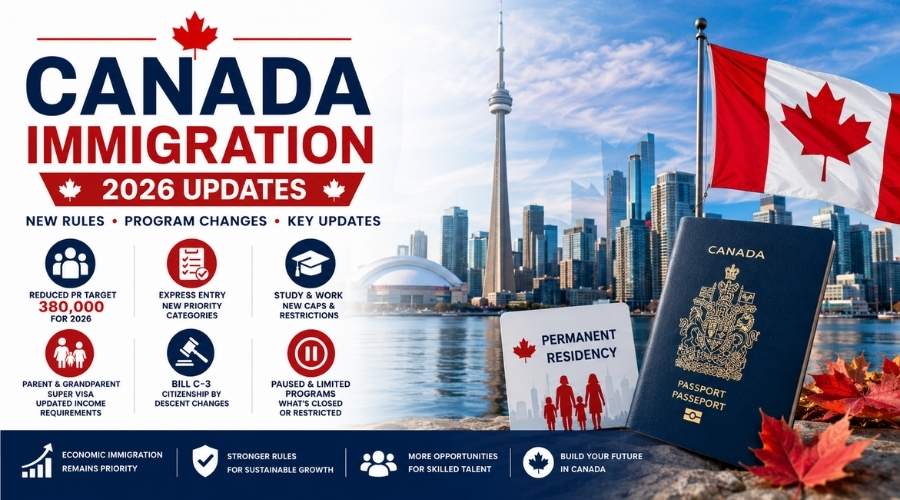
The most significant changes include a reduction in permanent resident admissions to 380,000, stricter limits on international students and temporary foreign workers, updated income requirements for the Parent and Grandparent Super Visa, and important citizenship reforms under Bill C-3.

If you are planning to move to Canada, understanding these changes is essential for choosing the right immigration pathway and preparing a competitive application.

Why Canada Changed Its Immigration Policies in 2026

In recent years, Canada experienced rapid population growth driven by high levels of permanent and temporary immigration. Although immigration remains critical to economic development, this growth increased demand for:

  • Housing and rental accommodation
  • Healthcare services
  • Schools and colleges
  • Transportation infrastructure
  • Public services

To ensure sustainable growth, the government adopted a more balanced immigration approach that aligns admissions with the country’s capacity to support newcomers successfully.

Key Canada Immigration Changes in 2026

Update What It Means
Permanent Resident Target Reduced Canada plans to admit approximately 380,000 new permanent residents in 2026
Temporary Resident Reduction Goal to reduce temporary residents to below 5% of Canada’s population
International Student Caps Provincial limits continue to restrict new study permits
Temporary Foreign Worker Restrictions Tighter employer compliance and reduced access in some sectors
Super Visa Income Changes Sponsors must meet updated financial thresholds
Bill C-3 Citizenship Reform Expanded citizenship by descent and restoration of citizenship in certain cases
Stronger Economic Focus Priority given to skilled workers and labour market needs

Permanent Resident Target Reduced to 380,000

One of the most important immigration updates for 2026 is the reduction of Canada’s permanent resident admissions target to approximately 380,000.

This lower target reflects the government’s intention to balance immigration with housing availability, infrastructure, and public services. Although admissions are reduced, Canada continues to prioritize economic immigration and family reunification.

Express Entry 2026: Priority Categories and New Trends

Express Entry remains Canada’s primary system for selecting skilled workers for permanent residence.

In 2026, invitations are increasingly targeted toward applicants with skills in high-demand sectors.

Priority Occupation Categories
Category Examples
Healthcare and Social Services Nurses, physicians, caregivers, therapists
Skilled Trades Electricians, plumbers, welders, carpenters
Education Teachers and early childhood educators
Transportation Truck drivers and transport specialists
French-Language Proficiency Candidates with strong French skills
Research and Advanced Talent Researchers and senior professionals
Foreign Medical Doctors Doctors with Canadian work experience

Applicants in these categories may receive invitations even with lower CRS scores than in general draws.

Provincial Nominee Program (PNP): One of the Best Pathways

The Provincial Nominee Program remains one of the strongest options for immigration to Canada.

Each province selects candidates whose skills match local labour shortages. A nomination through an Express Entry-linked stream adds 600 CRS points, effectively guaranteeing an invitation to apply for permanent residence.

Popular Provinces for Immigration
  • Ontario
  • British Columbia
  • Alberta
  • Saskatchewan
  • Manitoba
  • Nova Scotia

Temporary Residents to Be Reduced Below 5% of Population

Canada aims to reduce the total number of temporary residents—including international students and temporary foreign workers—to below 5% of the national population.

This policy has major implications for:

  • Study permits
  • Work permits
  • Open work permits for family members
  • Employer-sponsored LMIA applications

Applicants should expect more selective approvals and greater scrutiny of documentation.

International Student Policy Changes in 2026

International students continue to have opportunities in Canada, but admission has become more competitive.

Change Impact
Provincial Study Permit Caps Limits the number of new approvals
Stricter Financial Requirements Greater proof of funds may be required
Increased Institutional Oversight Focus on approved institutions with strong outcomes
Family Work Permit Restrictions Reduced eligibility for some spouses

Students should choose programs aligned with labour market needs to maximize future immigration opportunities.

Temporary Foreign Worker Program Restrictions

Canada has introduced stricter rules for employers using the Temporary Foreign Worker Program.

Key Changes
  • More employer inspections
  • Reduced use of low-wage foreign labour in some sectors
  • Stronger LMIA requirements
  • Greater focus on occupations facing genuine shortages

Workers in healthcare, construction, agriculture, and skilled trades continue to enjoy strong demand.

Parent and Grandparent Super Visa Income Updates

The Super Visa remains an important option for bringing parents and grandparents to Canada for extended visits.

In 2026, sponsors must meet updated income thresholds based on family size. Proper financial planning is essential before submitting an application.

Bill C-3: Citizenship by Descent Changes

Bill C-3 introduces significant reforms to Canada’s citizenship laws.

Main Benefits
  • Expands citizenship by descent beyond the first generation in certain cases
  • Restores citizenship to some previously excluded individuals
  • Allows transmission of citizenship if the Canadian parent accumulated sufficient physical presence in Canada

This legislation benefits many Canadian families living abroad.

Programs That Are Paused, Limited, or More Competitive

Program Current Status in 2026
Parent and Grandparent Program (PGP) Invitation-based and highly competitive
Some LMIA Work Permit Streams More restrictive and closely monitored
International Student Admissions Limited by provincial caps
Temporary Public Policies Several previous policies have expired

Best Immigration Pathways in 2026

Applicant Type Recommended Pathways
Skilled Professionals Express Entry, Provincial Nominee Program
Temporary Workers in Canada Canadian Experience Class, PNP
International Students Study Permit → PGWP → Permanent Residence
Entrepreneurs Start-Up Visa Program
Families Spousal Sponsorship, Super Visa

How to Improve Your Chances of Success

To remain competitive under Canada’s new immigration system, applicants should:

  • Achieve high IELTS, CELPIP, or TEF scores
  • Learn French to access additional selection categories
  • Gain experience in priority occupations
  • Secure a provincial nomination
  • Obtain Canadian education or work experience
  • Submit complete and accurate documentation
  • Monitor program openings and apply promptly

Is Canada Still a Good Country for Immigration in 2026?

Yes. Canada remains one of the most transparent and immigrant-friendly countries in the world. Although the system is more selective, the country continues to offer excellent opportunities for skilled professionals, students, entrepreneurs, and families.

With strong preparation and a strategic approach, Canada still provides one of the best pathways to permanent residence, citizenship, and long-term success.

Final Thoughts

Canada Immigration in 2026 is more focused, more competitive, and more aligned with sustainable population growth. Reduced immigration targets, tighter controls on temporary residents, and new citizenship rules require applicants to be better prepared than ever.

The most promising pathways remain Express Entry, the Provincial Nominee Program, family sponsorship, and study-to-permanent-residence strategies.

If you understand the latest rules and build a strong profile, Canada continues to offer outstanding opportunities to live, work, and build a secure future.

Read More

April 30, 2026

Getting a visa is not just about filling out forms or attending an interview. In reality, your success depends on something much bigger: your visa profile.

A strong visa profile tells a clear story about who you are, why you are traveling, and whether you are a genuine and reliable applicant. Immigration officers don’t just look at documents—they look for consistency, credibility, and intent.

In this guide, you’ll learn exactly how to build a strong visa profile step by step, whether you’re applying for a student visa, work visa, or visitor visa.

What Is a Visa Profile?

Your visa profile is the complete picture of your application, including:

  • Your travel history
  • Educational background
  • Job or financial status
  • Bank statements and assets
  • Purpose of travel
  • Ties to your home country
  • Overall consistency of documents

Think of it like a “trust score.” The stronger your profile, the higher your chances of approval.

1. Be Clear About Your Purpose

One of the most important parts of a strong visa profile is clarity of purpose.

You must be able to clearly explain:

  • Why you are traveling
  • Why this country
  • Why this university/job/tourist plan

For example:

Weak: “I want to go abroad for better opportunities.”
Strong: “I want to pursue a Bachelor’s in Information Technology to build a career in software development, as this field has strong demand in my home country.”

Clear purpose = strong profile foundation

2. Build a Solid Academic or Professional Background

Your background plays a huge role in visa approval.

For students:
  • Consistent academic performance
  • Relevant subject selection
  • Gap explanation (if any)
For workers:
  • Stable job history
  • Relevant experience
  • Promotions or skill growth

Officers look for one thing: progress, not confusion.

If your background matches your future plan, your profile becomes much stronger.

3. Maintain Strong Financial Proof

Financial stability is a key pillar of your visa profile.

You should be able to show:

  • Bank statements (consistent balance)
  • Sponsor income proof (if applicable)
  • Tax documents or business records
  • Proof of assets (if needed)
Important Tip:

Sudden large deposits without explanation can weaken your profile.

A strong financial profile shows:

“I can support my travel/study without financial risk.”

4. Build Travel History (If Possible)

Travel history is not mandatory for every visa, but it helps significantly.

A good travel record shows:

  • You followed visa rules before
  • You returned on time
  • You are a genuine traveler

Even small trips (neighboring countries or short visits) can strengthen your profile over time.

5. Show Strong Ties to Your Home Country

This is one of the most critical parts of a visa profile.

Visa officers want to know:

“Will this person return home after their visit?”

Strong ties can include:

  • Family responsibilities
  • Property or assets
  • Stable job or business
  • Long-term career plans in your home country

Example:

“After completing my studies, I plan to return and work in my country’s growing IT sector.”

This reduces immigration risk in the officer’s mind.

6. Keep Your Documents Consistent

Consistency is everything in visa applications.

Your:

  • Application form
  • Interview answers
  • Bank statements
  • Supporting documents
Common mistake:

Saying one thing in the interview and showing different information in documents.

Even small inconsistencies can create doubt.

7. Strengthen Your Digital and Social Profile (Optional but Useful)

For some visa categories, especially student and skilled migration visas, your online presence can matter.

A clean and professional profile includes:

  • LinkedIn account (for professionals)
  • Academic achievements
  • Certifications or courses
  • No suspicious or misleading content

It’s not mandatory, but it helps build credibility.

8. Avoid Red Flags That Can Weaken Your Profile

Even a strong applicant can face rejection due to avoidable mistakes.

Common red flags include:

  • Fake or unclear documents
  • Weak financial explanation
  • Poor interview preparation
  • Inconsistent information
  • No clear return plan
  • Sudden changes in purpose

9. Prepare a Strong Visa Story

Every strong visa profile has one thing in common: a clear story.

Your story should connect:

  • Past (education/work)
  • Present (current situation)
  • Future (travel purpose and return plan)

Example:

“I completed my bachelor’s in business, gained work experience in marketing, and now I want to pursue a master’s abroad to advance my career before returning home to join a multinational company.”

This creates trust and clarity.

Final Thoughts

Building a strong visa profile is not about luck—it’s about preparation and consistency.

If you focus on:

  • Clear purpose
  • Strong finances
  • Honest documentation
  • Career alignment
  • Return intention

Read More

April 3, 2026

Australia has introduced major immigration updates in 2026, focusing on creating a more controlled, skill-driven, and sustainable migration system. These changes aim to prioritize highly skilled professionals while reducing dependence on temporary visa pathways.

The new framework reflects Australia’s effort to balance economic growth, population management, and infrastructure capacity.

Purpose Behind the New Migration Strategy

In recent years, Australia has seen a rise in temporary visa holders, which has contributed to pressure on housing, public services, and infrastructure.

To address these issues, the government is shifting toward a more selective migration system that prioritizes quality over quantity, ensuring migrants contribute positively to the economy.

Limits on Repeated Visa Extensions

One of the major updates in Australia’s immigration system is the stricter control over repeated visa switching and continuous extensions. The government is now closely monitoring applicants who attempt to extend their stay by moving between different temporary visa categories without a clear long-term purpose. Under the new rules, such practices are more restricted, and applicants are required to demonstrate genuine intent for their stay in Australia. This change ensures that temporary visa pathways are used appropriately and not as a means to bypass immigration regulations.

As a result, applicants must now plan their visa strategy more carefully, choosing the correct visa type from the beginning rather than relying on repeated extensions. Strong documentation, clear purpose of stay, and alignment with visa requirements are now essential to avoid rejection or delays. This approach promotes a more structured and transparent migration system while encouraging applicants to follow legitimate and well-defined visa pathways.

Key changes include:

  • Tighter eligibility for visa renewals and transitions
  • Restrictions on continuous temporary visa extensions
  • Reduction in overall temporary migration numbers

This ensures applicants have a genuine purpose for staying in Australia.

Digital Upgrades in Visa Processing

Australia has significantly modernized its visa processing system by integrating advanced digital technologies, resulting in a more efficient and transparent application experience. These improvements allow applicants to track their application status in real time, reducing uncertainty and improving communication throughout the process. Automation and data-driven systems also help immigration authorities process applications faster while minimizing human error. As a result, well-prepared applications can move through the system more smoothly, especially when all required documents are submitted correctly. Overall, these digital upgrades are designed to create a faster, more user-friendly, and highly efficient visa processing environment.

Benefits for applicants:

  • Faster processing times
  • Real-time application tracking
  • Improved communication and transparency

These updates help streamline the visa process for qualified candidates.

Focus on Skilled Migration Programs

Skilled migration continues to be the foundation of Australia’s immigration strategy, with visa subclasses such as 190 and 491 playing a crucial role. These programs are designed to attract talented professionals who can contribute to key industries and support the country’s economic growth. Applicants must demonstrate relevant qualifications, work experience, and skills that match Australia’s demand occupations. State nomination pathways further enhance opportunities for candidates who may not qualify under federal criteria alone. By focusing on skill-based eligibility and meeting the required standards, applicants can secure a strong pathway toward permanent residency and long-term settlement in Australia.

Recent updates include:

  • Regular state nomination invitations
  • Focus on in-demand occupations
  • Increased income threshold (around AUD 76,515)

This ensures that migrants align with Australia’s workforce needs.

Stronger Compliance and Monitoring

The Australian government has reinforced its compliance and monitoring framework to ensure the integrity of its immigration system. These enhanced measures include stricter evaluation of visa holders, closer monitoring of visa conditions, and stronger penalties for any violations. Authorities now have greater control over identifying inconsistencies, preventing misuse, and ensuring that all applicants and visa holders follow the established rules. This approach helps maintain a fair and secure immigration system while protecting national interests. As a result, applicants must remain fully compliant, provide accurate information, and adhere to all visa conditions to avoid complications or potential visa cancellations.

New enforcement measures:

  • Closer monitoring of visa holders
  • Harsher penalties for violations
  • Greater regulatory control over migration flows

These steps help prevent misuse and maintain fairness in the system.

Real Impact on Visa Applicants

The updated immigration system in Australia offers significant advantages for highly skilled applicants while simultaneously increasing the overall eligibility standards. Candidates with strong qualifications, in-demand skills, and relevant work experience are more likely to benefit from faster processing and clearer migration pathways. However, applicants with weaker profiles or incomplete documentation may find it more challenging to qualify under the stricter requirements. The system now emphasizes quality over quantity, meaning only well-prepared and competitive candidates are prioritized. As a result, applicants must focus on building a strong profile, aligning their skills with Australia’s labor market needs, and ensuring full compliance with all visa requirements to improve their chances of success.

Applicants must now demonstrate:

  • Clear migration intent
  • Strong professional background
  • Financial stability

While opportunities remain strong, competition is now higher.

Effects on Students and Professionals

  • International students must align education with future career and PR pathways.
  • Professionals are favored if they meet skill demand and income requirements.

Australia continues to be an attractive destination, but success now requires better planning and qualifications.

Why These Reforms Were Introduced

The changes aim to:

  • Manage population growth
  • Reduce pressure on infrastructure
  • Support economic development
  • Prevent visa system misuse

These reforms ensure long-term sustainability of Australia’s migration system.

How to Succeed Under the New System

Stronger compliance and monitoring measures introduced by the Australian government require applicants to be more precise, transparent, and well-prepared throughout the visa process. To succeed, applicants must build strong, credible profiles that align with Australia’s immigration goals. This includes selecting the most suitable visa pathway based on individual skills, qualifications, and long-term career plans. It is also important to ensure that all documents are accurate, consistent, and verifiable, as even minor discrepancies can impact approval chances. Additionally, staying updated with policy changes and seeking professional guidance can significantly improve the likelihood of a successful application under the new system.

Key tips:

  • Develop relevant skills aligned with demand
  • Apply through appropriate skilled migration programs
  • Ensure complete and accurate documentation
  • Stay updated on policy changes

Strategic planning is now essential for success.

Conclusions

Australia’s 2026 immigration reforms clearly indicate a shift toward a more selective, skill-focused, and economically driven migration system. While opportunities still exist, applicants must meet higher standards and align with national priorities. Those who prepare strategically will find strong pathways for long-term success in Australia.

Read More

April 3, 2026
April 3, 2026

The United States has introduced major updates to its visa and immigration system in 2026, bringing stricter screening procedures and more advanced evaluation methods for applicants worldwide. These changes, effective from March 30, 2026, mark a shift toward a more secure, data-driven, and technology-based visa processing system.

Instead of relying only on traditional documentation, the U.S. now uses a broader approach that evaluates personal history, behavioral patterns, and digital footprints to assess each applicant’s eligibility.

Why the U.S. Introduced These Changes

In recent years, the rapid growth of visa applications and increasing global security concerns have exposed the limitations of older screening methods. To respond to these challenges, the U.S. government has implemented a more intelligent system that integrates data analysis and digital monitoring.

The primary goal is not to limit applicants, but to ensure that every candidate meets high standards of credibility, transparency, and legal compliance.

Expanded Visa Categories Under Review

One of the most significant updates in 2026 is the expansion of enhanced screening across a broader range of visa categories. Previously, stricter checks were mainly limited to student visas and skilled worker programs, but the new policy now includes many additional visa types under the same level of scrutiny. This change ensures that all applicants, regardless of their visa category, are evaluated with a consistent and thorough approach.

The expansion reflects the government’s commitment to strengthening immigration security while maintaining fairness across different applicant groups. By applying uniform screening standards, authorities can better assess the credibility, intent, and background of each individual. This also helps reduce inconsistencies in visa decisions and ensures that all pathways are aligned with national security and immigration objectives.

As a result, applicants from various categories must now meet higher standards of documentation, transparency, and eligibility. This broader coverage ultimately leads to a more secure and reliable visa system, where every application is carefully reviewed under the same strict guidelines.

Now included categories:

  • Training and internship-based visas and dependents
  • Family-based visas, including fiancé categories
  • Cultural and religious exchange programs
  • Humanitarian and protection visas
  • Domestic worker visa types

This expansion ensures equal and consistent evaluation across all applicants, regardless of visa type.

Social Media and Digital Activity Now Matters

A major transformation in the visa process is the inclusion of an applicant’s digital footprint as part of the evaluation criteria. Immigration authorities may review social media profiles, online interactions, and publicly available information to better understand an applicant’s background and intent. This includes checking for consistency between online activity and the details provided in the visa application. Applicants may also be required to disclose their social media history, depending on the visa category.

As a result, maintaining a clean, professional, and consistent online presence has become essential. Any misleading, conflicting, or suspicious online behavior can negatively impact the application outcome. This change highlights the growing importance of digital identity in modern immigration systems and emphasizes the need for applicants to manage their online presence responsibly.

Authorities may now review:

  • Public social media posts and interactions
  • Consistency between online profiles and application details
  • Professional and academic claims
  • Long-term digital history when required

Applicants may also be asked to disclose multiple years of social media activity, making digital behavior an important factor in visa approval decisions.

Stronger Background and Security Checks

The United States has strengthened its background verification system to enhance identity validation and improve overall security screening. These advanced checks involve multiple layers of verification, including cross-referencing global databases and conducting detailed assessments of an applicant’s background and intent. This ensures that only genuine and eligible individuals are approved for entry. The new system also helps identify inconsistencies, reduce fraud, and maintain strict immigration standards. As a result, applicants must ensure that their personal history, documentation, and declared intentions are fully transparent and consistent throughout the application process.

Key improvements include:

  • Multi-level identity verification
  • Cross-referencing with global security databases
  • Advanced analysis of applicant intent

These steps ensure that only genuine and qualified individuals are granted entry into the country.

What Applicants Will Experience

Due to stricter evaluation procedures, applicants may experience longer processing times and additional requests for supporting documents. The immigration authorities are now conducting more thorough checks, which can sometimes extend administrative processing periods. Applicants should be prepared to respond promptly to any requests and ensure that all submitted information is accurate and verifiable. While the process may take longer in some cases, these additional steps are designed to improve decision accuracy and maintain the integrity of the visa system. Overall, applicants who provide complete and consistent applications are more likely to experience smoother processing under the new system.

Possible outcomes:

  • Additional paperwork requests
  • Administrative processing delays
  • Extended background verification periods

However, applicants who submit accurate and complete applications will likely experience smoother processing.

Impact on Students, Workers, and Families

The new rules affect all categories of visa applicants.

  • Students must show clear academic intent and maintain consistent records.
  • Skilled workers need verified professional experience and strong documentation.
  • Family-based applicants are also subject to detailed evaluation to ensure authenticity.

The overall focus is now on alignment between documents, intent, and digital identity.

Reasons Behind the Policy Reform

The changes were introduced to strengthen national security, improve visa system efficiency, and adapt to the growing influence of digital information in modern decision-making.

The government also aims to ensure fairness, consistency, and transparency in all visa decisions.

How to Prepare for the New System

Applicants should adopt a strategic and well-planned approach to improve their chances of approval under the updated system. This includes carefully reviewing all visa requirements, preparing accurate and complete documentation, and ensuring consistency across all submitted information. Maintaining a professional online presence is also increasingly important, as digital activity is now part of the evaluation process. Applicants should avoid any discrepancies between their application and their digital footprint, as this can raise concerns during screening. Additionally, seeking guidance from experienced visa consultants and applying well in advance can help reduce the risk of delays and improve overall success rates. Proper preparation, attention to detail, and honesty are key factors in navigating the new visa environment effectively.

Key recommendations:

  • Maintain a clean and professional online presence
  • Ensure all documents are accurate and consistent
  • Apply well in advance of deadlines
  • Stay honest throughout the application process

Proper preparation can significantly increase approval success under the new system.

Conclusions

The 2026 U.S. visa reforms mark a major step toward a more secure and technology-driven immigration system. While opportunities remain strong for international applicants, meeting higher standards of credibility and consistency is now essential. Those who prepare carefully and present transparent, well-documented profiles will have the best chances of success.

Read More

April 2, 2026

Canada has officially taken a major step toward strengthening its immigration system. On March 26, 2026, Bill C-12 received Royal Assent, marking a significant shift in how immigration and asylum applications are handled across the country.

This new law focuses on improving efficiency, tightening security, and ensuring fairness—while also addressing long-standing issues such as processing delays and misuse of asylum pathways.

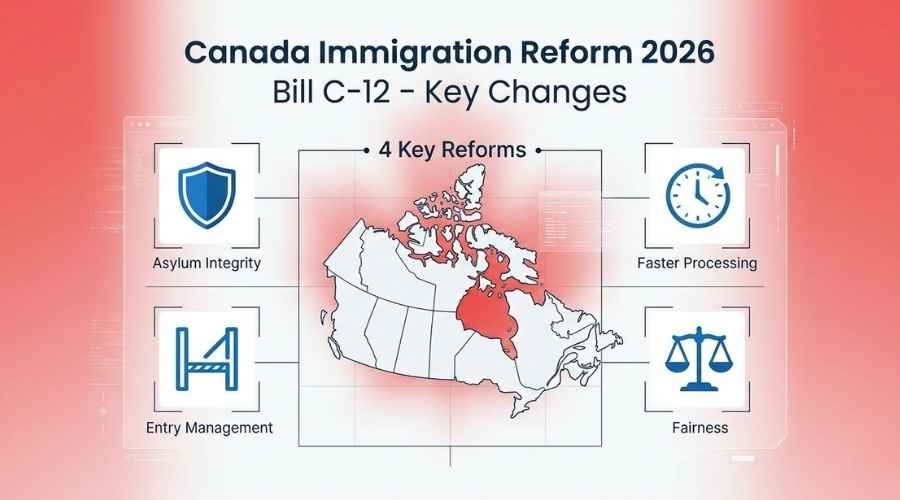
In this blog, we’ll explore the 4 key reform areas of Bill C-12, what they mean in practice, and how they will impact future applicants.

What is Bill C-12 and Why It Matters?

Bill C-12 is part of Canada’s ongoing effort to modernize its immigration system under Immigration, Refugees and Citizenship Canada (IRCC).

Over the past few years, Canada has experienced a surge in immigration and asylum applications, putting pressure on existing systems. This law aims to solve those challenges while maintaining Canada’s reputation as a welcoming destination.

The goal is not to reduce immigration—but to ensure that the system is efficient, fair, and protected from misuse.

The 4 Key Areas of Reform Under Bill C-12

1. Stronger Asylum System Integrity

Bill C-12 introduces stricter measures to protect Canada’s asylum system from misuse and fraudulent claims. Authorities will now have better tools to quickly identify applications that do not meet genuine refugee criteria, helping prevent system abuse.

At the same time, the law ensures that legitimate asylum seekers are not negatively affected. By reducing false or weak claims, genuine refugees can receive faster decisions and better support upon arrival.

This change is expected to significantly reduce backlogs in asylum processing, creating a more balanced and effective system that prioritizes those truly in need of protection.

2. Faster Processing and Reduced Backlogs

One of the biggest improvements under Bill C-12 is the focus on speeding up immigration processing times. Canada has faced delays across multiple visa categories, and this law introduces modern solutions to address those issues.

Through increased digitization, automation, and better case management systems, applications will be processed more efficiently. This means fewer delays for study permits, work permits, and permanent residency applications.

Additionally, resources within IRCC are expected to be better allocated, ensuring that high-demand categories are handled quickly while maintaining accuracy and fairness in decision-making.

3. Enhanced Border and Entry Management

The new law strengthens Canada’s border control measures to ensure that all entries into the country are properly monitored and regulated. This includes improved coordination between immigration authorities and border enforcement agencies like the Canada Border Services Agency (CBSA).

With enhanced screening procedures, individuals entering Canada will undergo more thorough checks to verify their purpose of travel and eligibility. This reduces the risk of unauthorized entry or misuse of temporary visas.

At the same time, these improvements help maintain national security while ensuring that genuine travelers, students, and workers can enter Canada smoothly without unnecessary delays.

4. Fairness and Accountability in Decision-Making

Bill C-12 places strong emphasis on making immigration decisions more transparent and consistent. Applicants will benefit from clearer communication regarding application outcomes and reasons for approval or refusal.

The law also introduces improvements in how appeals and reviews are handled, ensuring that applicants have fair opportunities to challenge decisions if necessary. This increases trust in the overall system.

By standardizing decision-making processes, Canada aims to reduce inconsistencies and ensure that every applicant is treated equally, regardless of their country of origin or application type.

What This Means for Immigrants and Applicants

1. Stricter Screening but Faster Decisions

Applicants should expect more detailed background checks and verification processes, especially in categories prone to misuse. However, these stricter checks are balanced with faster processing systems that reduce waiting times.

This means genuine applicants will benefit the most, as their applications will move through the system more quickly and with fewer delays compared to previous years.

Overall, the process becomes more competitive—but also more efficient for those who are well-prepared.

2. Higher Standards for Genuine Applicants

Canada is clearly shifting toward prioritizing applicants who have clear intentions and strong documentation. This includes students with relevant academic plans, workers with valid job offers, and immigrants with genuine long-term goals.

Incomplete, inconsistent, or weak applications are more likely to face rejection under the new system. This makes preparation and accuracy more important than ever before.

For serious applicants, however, these changes improve overall approval chances by reducing competition from non-genuine cases.

3. Reduced Misuse of Immigration Pathways

The new law aims to close loopholes that were previously used to misuse asylum or temporary visa programs. This ensures that immigration pathways are used for their intended purposes only.

By limiting misuse, Canada can better manage application volumes and provide faster services to those who genuinely qualify.

This also helps maintain the integrity and global reputation of Canada’s immigration system.

How This Impacts Students and Workers

Although Bill C-12 mainly targets system efficiency and asylum reforms, its impact extends to international students and skilled workers.

Students may experience faster visa decisions but should be prepared for stricter documentation and credibility checks. Clear study plans and financial proof will be essential.

Similarly, workers and permanent residence applicants may benefit from reduced processing times, but only if their applications meet all eligibility criteria accurately and honestly.

Why Canada Introduced Bill C-12

There are several reasons behind this major reform:

  • A sharp increase in immigration and asylum applications in recent years
  • Growing backlogs causing delays across multiple visa categories
  • Concerns about misuse of refugee and temporary visa systems
  • The need to maintain public trust and system transparency

Ultimately, Canada aims to create a system that is both welcoming and well-controlled.

What Applicants Should Do Now

1. Prepare Strong Documentation

Make sure all documents—financial, academic, and personal—are accurate, complete, and verifiable. Even small inconsistencies can lead to delays or refusals under stricter rules.

2. Apply as Early as Possible

With high application volumes, early submission remains critical. Applying well in advance gives you enough time to handle unexpected delays or additional document requests.

3. Be Honest and Transparent

Providing truthful and consistent information is now more important than ever. Misrepresentation can lead to serious consequences, including bans from applying.

4. Stay Updated with Policy Changes

Immigration policies continue to evolve, so staying informed through official IRCC updates or professional advisors is essential for success.

Final Thoughts

Bill C-12 marks a major transformation in Canada’s immigration system in 2026. By focusing on integrity, efficiency, and fairness, the government aims to create a system that benefits genuine applicants while preventing misuse.

For those planning to move to Canada, the opportunity is still strong—but preparation is now the key to success.

Canada remains one of the world’s top destinations for students, workers, and immigrants—but in 2026, only well-prepared and genuine applicants will truly benefit from these opportunities.

Read More

February 17, 2026

The year 2026 is becoming one of the most important years in global immigration. Many countries are simultaneously facing labor shortages, aging populations, housing pressure, and economic changes. Because of this, governments are adjusting visa policies — some countries are making immigration easier, while others are tightening rules.

If you are planning to study abroad, work abroad, or apply for PR (permanent residency), understanding these changes is extremely important. A wrong plan based on old information can lead to visa refusal, financial loss, or even bans.

This guide explains the major immigration changes happening across the world in 2026 in a simple and practical way.

Why Immigration Rules Are Changing in 2026

Before discussing each country, you need to understand the real reason behind these changes.

Globally, countries are dealing with three major issues:

1. Labor Shortage
Many developed countries (Canada, Germany, UK, Australia, Japan) don’t have enough workers. Their local population is aging and fewer young people are entering the workforce.

2. Housing & Cost of Living Crisis
Countries like Canada, UK, and Australia received too many newcomers after COVID-19 reopening. Housing prices increased sharply, so governments are now trying to control immigration numbers.

3. Abuse of Student Visas
Some people used student visas mainly as a pathway to work illegally or stay permanently. Because of this, many countries are now verifying students more strictly.

So the new policies in 2026 are basically:
“We still need immigrants — but we want genuine and qualified applicants.”

Canada — Controlled Student Entry, More Focus on PR Candidates

Canada remains one of the top destinations, but 2026 marks a turning point. The government is trying to balance housing pressure and worker shortage at the same time.

What Changed in 2026

Policy Area New Direction What It Means for Applicants
Student Intake Limited intake numbers Fewer study permits approved
Colleges Restrictions on low-quality private colleges Choosing the wrong college = high refusal risk
Financial Proof Increased living cost requirement Stronger bank documentation needed
PR Pathway More provincial nomination importance PR easier through skilled job, not just study
Work Demand Skilled trades prioritized Electricians, healthcare, construction in demand

Real Impact

Earlier, many students used small colleges just to enter Canada.
Now Canada wants career-oriented students and workers who can stay long-term.

United Kingdom — Student Route Still Open, But Settlement Harder

The UK didn’t close its doors — it changed its priorities.

The government found that too many applicants were using the student visa mainly to bring family members and settle quickly. So the system was redesigned.

UK Immigration Update

Policy 2026 Rule Effect
Student Dependents Mostly restricted Students cannot easily bring spouse/children
Work Visa Higher salary threshold Only skilled jobs qualify
Universities Compliance checks increased Low-ranked colleges risky
Graduate Route Still active 2-year post-study work allowed
Financial Requirement Strict verification Fake sponsorship easily detected

Real Impact

If your goal is education and career, the UK is still excellent.
If your goal is quick settlement, it has become difficult.

Students admitted to recognized universities still have strong success chances.

Australia — Genuine Student Requirement

Australia introduced the most important immigration concept of 2026:

You must prove you are a real student, not a disguised worker.

Australia Policy Changes

Area New Rule Visa Officer Focus
GSR (Genuine Student Requirement) Mandatory Why this course? Why Australia?
SOP Review Deep analysis Career relevance checked
Finances Verified carefully Source of funds examined
Course Matching Important Irrelevant courses often refused
Work Motivation Negative factor Work-focused answers risk refusal

Real Impact

In 2026, Australia visas depend heavily on:

  • Study background

  • Career plan

  • Interview answers

Random course selection is now one of the top refusal reasons.

United States — Credibility-Based Visa System

The USA did not reduce student visas, but it increased scrutiny.
Instead of document-based approval, the US mainly relies on the interview decision.

USA 2026 Changes

Section Update Meaning
Interview More detailed questions Officer checks confidence & clarity
Funding Verified strongly Sponsor credibility important
SEVIS Monitoring Strict Attendance matters
OPT Remains available Major job opportunity
STEM Programs Encouraged Tech & engineering preferred

Real Impact

The US visa depends on one thing:
Your explanation of your future plan.

Students with clear academic goals continue to succeed.

Germany & Europe — The Most Open Immigration System in 2026

While English-speaking countries tightened student entry, Europe moved in the opposite direction.

Germany especially faces a massive labor shortage and is actively attracting foreigners.

Germany & Europe Update

Policy New Opportunity Benefit
Opportunity Card Points-based job seeker visa Enter Germany without job offer
Student Work Increased work hours Earn during study
Tuition Fees Very low Affordable education
PR Pathway Faster for workers Settlement opportunity
Language Flexible in some sectors English programs available

Real Impact

Europe has become the top alternative destination for students rejected elsewhere.

Germany is now popular because:

  • Low cost

  • Legal work

  • Residency pathway

UAE & Saudi Arabia — Long-Term Residency Model

The Middle East is transforming from a temporary worker region into a permanent expat living destination.

Middle East Changes

Country Program What It Offers
UAE Golden Visa 5–10 year residence
UAE Skilled Worker Visa Professional job residence
Saudi Arabia Premium Residency Long-term stay rights
Saudi Arabia Property Ownership Foreigners allowed investment
Both Business Visas Entrepreneur opportunities

Real Impact

These countries now target:

  • Entrepreneurs

  • Investors

  • Professionals

It is no longer only a short-term labor migration region.

Asia — Emerging Study Destinations

Asian countries are quietly becoming strong competitors in international education.

Asia Immigration Updates

Country New Attraction Advantage
Japan English programs Work after study
South Korea Tech education Scholarships
Malaysia Affordable tuition Easy visa processing
Japan/Korea Worker visas Aging population demand

Real Impact: Students who cannot afford Western countries now have realistic and legal options in Asia.

Biggest Global Trend in 2026

Across almost every country, immigration policies now follow one principle:

Quality over Quantity

Governments now check:

  • Genuine student intention

  • Academic background

  • Financial stability

  • Career relevance

  • English proficiency

  • Documentation authenticity

Fake documents, weak SOPs, and random course selection are now the main reasons for visa refusal worldwide.

How Applicants Should Prepare in 2026

If you are planning to apply abroad this year, you must change your strategy.

You should:

  • Choose course relevant to your previous study

  • Prepare a strong SOP

  • Show real financial documents

  • Select recognized institutions

  • Have a clear career plan

You should NOT:

  • Apply randomly

  • Change study field without explanation

  • Submit fake bank statements

  • Depend only on agents

Final Thoughts

Immigration is not ending in 2026 — it is evolving.

Countries still need immigrants, students, and skilled workers. But now they want serious, qualified, and genuine applicants.

For prepared candidates, 2026 may actually be one of the best opportunities in recent years.
For unprepared applicants, it may become the most difficult time.

So success now depends less on luck and more on planning, documentation, and strategy.

Read More

October 20, 2025

The United Kingdom has announced a major update to its immigration rules by raising the English-language requirement for many visa categories. This change is part of the government’s long-term plan to strengthen integration, improve workplace communication, and ensure that newcomers can participate more effectively in UK society. While the policy is aimed at improving outcomes, it also creates new challenges for applicants who are planning to work, study, or settle in the country.

What Has Changed?

Until now, many UK visa categories — especially work-related routes — accepted English proficiency at the B1 level. Under the new rules, the required level will increase to B2 for a significant number of applicants. This means that applicants will need stronger listening, speaking, reading, and writing skills than before.

In addition to main applicants, adult dependants will now also face English requirements. Those joining family members in the UK will be required to show a basic level of English at the time of entry, and gradually meet higher standards when extending their visa or applying for settlement.

What Is the Difference Between B1 and B2?

To understand the impact, it helps to break down the language levels:

Level Meaning Skill Expectation
B1 – Intermediate Can handle everyday communication and familiar topics Suitable for basic work and social situations
B2 – Upper-Intermediate Can understand complex ideas and interact fluently Suitable for professional environments and deeper communication

The jump from B1 to B2 is significant. A B2 speaker must be able to express opinions, explain ideas clearly, interact confidently with native speakers, and understand more advanced language in the workplace.

Who Will Be Affected?

The new English-language rules will apply to:

  • Skilled Worker Visa applicants

  • Other professional or work-based visa routes

  • Adult dependants of workers and students

  • Applicants aiming for long-term residence or settlement

Anyone planning a UK immigration pathway that leads to employment or permanent settlement should be prepared for a higher language standard.

Implications for Applicants & Employers

This policy shift has direct consequences for both migrants and UK employers.

For Applicants:
Immigrants will need more preparation before applying, as the bar for acceptable English has been raised. Some candidates may need additional language training or may have to sit for their exams multiple times. The process might become more time-consuming and costly, but meeting the standard will improve communication confidence and workplace readiness once in the UK.

For Employers:
UK companies hiring from abroad must now ensure that international candidates meet the new language criteria before sponsorship. While this adds an extra layer of screening, it also ensures that future employees will require less language support and will integrate more smoothly into professional environments. Employers may face a slightly reduced talent pool but potentially gain stronger long-term hires with better communication skills.

Why Is the UK Making This Change?

The UK government says the higher English requirement is intended to:

  • Support better integration into British society

  • Improve communication in the workplace

  • Reduce pressure on public services

  • Encourage migrants who are ready for long-term contribution and settlement

In short, the government wants newcomers who can adapt quickly, work confidently, and fully participate in community life.

What Does This Mean for Applicants?

For many people, this change means extra preparation and planning. Meeting the B2 requirement may require:

  • More intensive English study

  • Longer preparation time before applying

  • Additional test attempts if a first attempt falls short

Applicants will need to prove their English level through an approved test or an accepted educational qualification taught in English.

If you plan to bring your family, remember that adult dependants will also need to prepare, which may affect your application timeline.

Tips for Future UK Visa Applicants

If you are planning to apply under a UK work or settlement route, here are some smart steps to take now:

  1. Assess your current English level — Find out whether you are closer to B1 or B2.

  2. Start improving early — Don’t wait until the application stage to begin preparing.

  3. Practice all four skills — Focus on speaking and writing, as these are where most applicants struggle.

  4. Plan for dependants — If you are bringing a spouse or adult family member, ensure they begin learning early.

  5. Apply sooner if eligible — If you meet current rules, consider whether early application benefits you before the changes take effect.

Conclusion

The UK’s move to raise English-language requirements marks a major shift in its immigration system. While it raises the bar for applicants, it also reflects the country’s expectation that migrants will contribute actively to society and the workplace. With proper preparation and early planning, applicants can still achieve their UK goals — but waiting until the last moment could lead to delays, setbacks, or missed opportunities.

If you or your dependants are planning to apply for a UK visa, now is the time to prepare, improve your English skills, and review your application strategy. A well-planned approach today will save time, stress, and cost in the future.

Read More

September 22, 2025

The United States has long been a top destination for skilled professionals from around the world, especially through the H-1B visa program. But with the Trump administration’s latest move, the landscape for employers and international talent may be changing dramatically. A new policy introduces a $100,000 fee for companies sponsoring certain skilled worker visa applicants. This shift could reshape hiring strategies, impact global talent flows, and raise important questions about the future of U.S. immigration.

What’s Changing

Under the new rule, employers who file new H-1B petitions for workers outside the United States will be required to pay an additional $100,000 fee.

Key points to note:

  • The fee applies to new applications, not renewals.

  • Skilled workers already in the U.S. on H-1B visas are not directly affected.

  • The policy took effect in September 2025.

  • Employers must prove payment as part of the petition process.

This is on top of existing filing fees, making the cost of sponsoring skilled workers significantly higher.

Why the Change?

The stated goal is to:

  • Protect U.S. jobs by making it more expensive to hire foreign talent.

  • Reduce alleged “abuse” of the H-1B system by outsourcing firms.

  • Encourage higher wages and investment in American workers.

Supporters see this as a way to prioritize U.S. workers, while critics argue it could harm innovation and competitiveness.

Impact on Employers

For businesses, this policy is a game changer.

  • Higher Costs: What used to cost a few thousand dollars now requires a six-figure investment.

  • Strategic Hiring: Companies may reserve H-1B sponsorships for only the most critical, senior, or highly specialized roles.

  • Startups & Small Firms: Smaller businesses will feel the burden most, as many cannot afford the added cost.

  • Global Competition: Employers may consider shifting jobs overseas or relying more on remote work solutions.

Impact on Skilled Workers

For international professionals seeking opportunities in the U.S., the picture is mixed.

  • Fewer Opportunities: Companies may cut back on sponsoring foreign workers.

  • Selective Hiring: H-1Bs may go primarily to top-tier talent where the fee can be justified.

  • Increased Uncertainty: Visa sponsorship could become harder to secure, especially for entry-level or less specialized roles.

  • Alternative Routes: Applicants may need to explore other visa categories or consider destinations outside the U.S.

Pros and Cons

Pros

  • Encourages higher wages for U.S. workers.

  • Reduces misuse of the H-1B system.

  • Directs H-1B visas toward truly specialized positions.

Cons

  • Creates barriers for global talent.

  • Puts heavy financial strain on smaller businesses.

  • Risks pushing jobs and innovation outside the U.S.

What Employers and Applicants Should Do

  1. Review pending and future petitions to determine if the new fee applies.

  2. Plan budgets accordingly, especially if hiring from abroad.

  3. Consult with immigration experts to explore alternative visa pathways.

  4. Communicate with prospective hires about costs, timelines, and expectations.

  5. Stay updated, as policies may evolve with legal challenges or future adjustments.

Conclusion

The $100,000 fee for skilled worker visa applications marks a major shift in U.S. immigration policy. While designed to protect American workers, it also places new burdens on global businesses and international professionals. For employers, the challenge is balancing cost with the need for top talent. For skilled workers, the challenge is navigating a tougher path to opportunities in the U.S.

Read More

July 14, 2025

Canada is known for its openness, multiculturalism, and traveler-friendly policies. In recent years, the Canadian government has taken steps to simplify entry procedures for select international travelers through visa waivers or Electronic Travel Authorization (eTA). As of 2025, travelers from several Asian countries can now visit Canada visa-free or with an eTA, making travel more accessible for tourism, short business trips, or visiting family.

In this blog, we explore the 10 Asian countries that currently benefit from visa-free access or simplified eTA entry to Canada, who qualifies, and what travelers need to know before they pack their bags.

What Is Visa-Free or eTA Travel to Canada?

Before we dive into the list, let’s clarify what visa-free travel means.

  • Visa-free: You do not need a visa to enter Canada if you meet specific conditions.

  • eTA (Electronic Travel Authorization): A quick, online travel permit required for visa-exempt nationals arriving by air.

For many Asian travelers, Canada offers visa-free travel if they have previously held a Canadian visa or currently hold a valid U.S. non-immigrant visa. These travelers can apply for an eTA instead of a full visa, saving both time and money.

10 Asian Countries Eligible for Visa-Free or eTA Entry to Canada (2025)

Here’s a list of countries whose nationals may travel to Canada visa-free or under the eTA system, subject to conditions.

1. Philippines
  • Eligible for eTA if the traveler held a Canadian visa in the last 10 years or currently holds a valid U.S. non-immigrant visa.

  • eTA is required for air travel.

2. Thailand
  • Thai nationals can apply for eTA if they meet the same criteria: past Canadian visa or current U.S. visa.

3. Indonesia
  • Indonesian travelers benefit from the eTA program under the same visa history conditions.

4. Vietnam
  • Citizens of Vietnam are eligible for an eTA under Canada’s expanded travel facilitation initiative (with valid travel history).

5. Malaysia
  • Malaysian passport holders who meet the criteria can now apply for an eTA to visit Canada.

6. India
  • Indian citizens with a valid U.S. visa or Canadian visa issued in the last 10 years can travel using an eTA.

  • Not visa-free for all Indian passport holders — must meet travel history conditions.

7. Taiwan
  • Taiwanese passport holders with a personal identification number (PIN) on their passport are already visa-exempt for short visits.

  • Still require eTA when flying to Canada.

8. South Korea
  • South Korean citizens do not need a visa and only need to apply for an eTA.

  • Considered a fully visa-exempt country.

9. Singapore
  • Singaporean passport holders enjoy visa-free access to Canada for short stays.

  • Only an eTA is needed when traveling by air.

10. Japan
  • Japan is a long-standing visa-exempt country.

  • Travelers need an eTA if arriving by air, but no visa is required for visits under 6 months.

Benefits of Visa-Free or eTA Entry

  • No embassy visits or interviews

  • Lower application costs (eTA costs only 7 CAD)

  • Faster approvals, usually within minutes to a few hours

  • Greater travel flexibility for students, businesspeople, and families

  • Improved tourism and cultural exchange with Canada

Eligibility Criteria: Do You Qualify?

To qualify for an eTA instead of a visa, you usually must:

✅ Be a citizen of one of the listed countries
✅ Have held a Canadian visa in the last 10 years or currently hold a valid U.S. non-immigrant visa
✅ Travel to Canada by air (eTA is not valid for land or sea entry)
✅ Have a valid biometric passport

👉 Check your eligibility on the official Canadian immigration site or consult with a visa expert like SchoolingVisa.

How to Apply for an eTA

  1. Visit the official Government of Canada eTA site

  2. Complete the online application

  3. Pay the CAD 7 fee

  4. Wait for approval (usually minutes to 72 hours)

  5. Get your eTA linked to your passport

Travel Tips for Visa-Free Visitors to Canada

  • Keep your return ticket & travel plans handy for immigration questioning

  • Get travel insurance for medical emergencies

  • Ensure your passport is valid for at least 6 months

  • Don’t overstay — eTA allows visits up to 6 months only

  • Avoid working or studying without the proper permits

Final Thoughts: A New Era for Asian Travelers to Canada

This expansion of visa-free or eTA eligibility reflects Canada’s commitment to building stronger ties with Asian countries. Whether you’re visiting Niagara Falls, studying in Toronto, or exploring Vancouver’s vibrant neighborhoods, the journey has never been easier.

If you’re unsure whether you qualify, or want help with your study permit, work visa, or visitor visa, the experts at  GlobalVisaNet are here to help you navigate every step.

Read More

February 27, 2025

On February 18, 2025, the Saskatchewan Immigrant Nominee Program (SINP) announced a temporary suspension of new Job Approval Forms (JAFs) submissions. This decision comes in response to the federal government’s move to reduce provincial nomination allocations by 50% for the year 2025.

Understanding the SINP and JAFs

The SINP serves as a crucial pathway for foreign workers aiming to secure permanent residency in Saskatchewan. Employers intending to hire international talent must first submit a JAF to obtain a Job Approval Letter (JAL). This letter enables the prospective employee to apply for provincial nomination, setting them on the path to permanent residency. With the current pause on JAF submissions, new employer-supported applications are temporarily on hold.

Reasons Behind the Suspension

The federal government’s Immigration Levels Plan for 2025-2027 has significantly reduced overall immigration numbers, including a 50% cut to the Provincial Nominee Program (PNP) allocations. This reduction has directly impacted Saskatchewan’s ability to nominate candidates, prompting the SINP to reassess and adjust its processes accordingly.

Implications for Employers and Foreign Workers

The suspension of JAF submissions presents challenges for both employers and prospective immigrants:

  • Employers: Businesses relying on the SINP to address labor shortages will need to explore alternative avenues for hiring foreign talent. Options include the Temporary Foreign Worker Program (TFWP), which necessitates obtaining a Labour Market Impact Assessment (LMIA), or leveraging the federal Express Entry system.

  • Foreign Workers: Individuals seeking permanent residency through employer sponsorship in Saskatchewan may experience delays. It’s advisable for these candidates to consider other immigration pathways, such as direct applications through the Express Entry system or exploring opportunities in other provinces.

Duration and Future Outlook

The SINP has indicated that this pause is temporary, expected to last several weeks. During this period, the program will review existing applications and implement necessary adjustments to align with the reduced nomination allocations. No specific date has been provided for when JAF submissions will resume. Stakeholders are encouraged to stay informed through official SINP communications for updates on the situation.

Conclusion

The temporary suspension of JAF submissions by the SINP reflects broader changes in Canada’s immigration landscape. Both employers and foreign workers are urged to explore alternative pathways and stay abreast of updates to navigate this transitional period effectively.

Read More