
Loading...
Hi, How Can We Help You?

Category Archives: Education Visa

August 29, 2025
August 29, 2025

The International English Language Testing System (IELTS) is one of the most widely accepted methods of assessing English language proficiency. It has four sections: Listening, Reading, Writing, and Speaking. Among these, the Speaking test often feels the most challenging for candidates.

Many test-takers believe that fluency, vocabulary, and grammar are enough to score high. However, despite having strong English skills, many candidates remain stuck at Band 6 or lower in Speaking. Why? The missing piece is often Pronunciation—a crucial but overlooked factor that makes up 25% of the IELTS Speaking score.

In this blog, we will explore why pronunciation matters, common mistakes candidates make, and practical ways to improve it for a higher IELTS Speaking score.

Why Pronunciation Matters in IELTS Speaking

A common misconception is that you need a British or American accent to score well in pronunciation. In reality, IELTS does not test your accent. Instead, examiners focus on whether:

  • You can be understood clearly,

  • You use a natural tone,

  • You place the right emphasis on words and sentences.

Even with strong grammar and vocabulary, unclear pronunciation can make your answers difficult to understand—leading to a lower band score.

Key Aspects of Pronunciation in IELTS Speaking

1. Correct Pronunciation of Sounds (Phonemes)

Some English sounds do not exist in other languages like Bengali, which often leads to mistakes. For example, confusing “v” and “b” or “ship” and “sheep.” Such errors can change meanings and affect clarity.

How to Improve:

  • Use tools like Cambridge Dictionary or Google Dictionary to listen to correct pronunciations.

  • Practice minimal pairs (e.g., “ship/sheep,” “bit/beat”) to sharpen your sound accuracy.

2. Word Stress – Emphasizing the Right Syllable

English words often have more than one syllable, and stressing the wrong syllable can make a word sound incorrect. For example:

  • CORrect (✔️) vs. corRECT (❌)

  • PREsent (noun) vs. preSENT (verb)

How to Practice:

  • When learning new words, always check the stress in a dictionary.

  • Listen to real examples on platforms like YouGlish and imitate them.

3. Sentence Stress – Emphasizing Key Words

In English, not all words in a sentence carry equal weight. Important words (nouns, verbs, adjectives) are stressed, while smaller words (articles, prepositions) are spoken more softly. For example:

👉 “I went to the store to buy some apples.”

How to Practice:

  • Read short sentences and underline the key words.

  • Record yourself and check if your stress matches natural English rhythm.

  • Practice in front of a mirror to improve clarity and confidence.

4. Intonation – Avoid Monotone Speech

Intonation is the rise and fall of your voice while speaking. Speaking in a flat, monotone voice makes your speech sound robotic and lowers your confidence.

For example:

  • Rising intonation → “Are you coming?”

  • Falling intonation → “I’m going home.”

  • Rise-fall intonation → “That’s amazing!”

Techniques to Improve Intonation:

  • Listen to native speakers and copy their tone.

  • Say the same sentence in different emotions (question, surprise, statement).

  • Record yourself to ensure you sound natural, not robotic.

5. Connected Speech – Linking Words Naturally

Native speakers often link words together instead of pronouncing them separately. For example:

  • “What are you doing?” → “Whatcha doin’?”

  • “I want to” → “I wanna.”

While you don’t need to force slang, speaking with connected flow instead of a robotic word-by-word delivery will make you sound more natural.

How to Practice:

  • Watch movies, TV shows, or YouTube videos of native speakers.

  • Immediately repeat and mimic their connected speech.

6. Clear Enunciation – Pronouncing Words Clearly

Even if you know advanced vocabulary, if you swallow your words or speak unclearly, the examiner won’t understand you. Clarity is more important than speed or accent.

How to Improve:

  • Record yourself and check if every word is clear.

  • Read aloud from news articles or TED Talk transcripts daily.

  • Mimic not just the words but also the style of native speakers.

Final Thoughts

Many IELTS candidates spend time memorizing vocabulary lists or practicing fluency drills, but they forget that pronunciation alone accounts for 25% of the Speaking score.

To score Band 7 or higher, remember:

  • Correct sounds matter.

  • Stress and intonation bring your speech to life.

  • Connected, clear, and natural speech makes you easy to understand.

The IELTS Speaking test is not about “what you say” but also “how you say it.” By focusing on pronunciation and practicing every day, you can improve your clarity, confidence, and overall score.

Pro Tip: Spend at least 15 minutes daily on pronunciation practice—record, listen, and adjust. Over time, you’ll sound more natural and confident, boosting your chances of achieving a higher band score.


Read More

January 7, 2025

If you’re an international student aiming to study in Australia, staying informed about updates to the student visa application process is crucial. Beginning January 1, 2025, a significant update will affect onshore student visa applicants. The Australian Department of Home Affairs will no longer accept Letters of Offer from educational institutions as part of the visa application. Instead, applicants must provide a Confirmation of Enrolment (CoE) when submitting their student visa application.

What Is a Confirmation of Enrolment (CoE)?

A Confirmation of Enrolment (CoE) is a formal document provided by an Australian educational institution, confirming that you are officially enrolled in a course. Unlike a “Letter of Offer,” which simply indicates that you’ve been offered a place in a course, the CoE proves that you have fulfilled all necessary requirements and are officially enrolled, ready to begin your studies.

The CoE includes essential details such as your course name, duration, and the educational institution where you’re studying. This change will make the process more efficient and reliable for both students and the Australian government.

Why Is This Change Happening?

The introduction of the Confirmation of Enrolment requirement aims to increase the accuracy and integrity of the student visa application process. Prior to 2025, the Letter of Offer was enough for a student to apply for a visa, but it didn’t always guarantee that the student was officially enrolled. The CoE ensures that only students who are fully enrolled in a course are applying for a visa, reducing the possibility of fraudulent applications.

What Does This Mean for You?

If you’re applying for a student visa while already in Australia (onshore applicants), this new rule means you need to make sure you have your Confirmation of Enrolment (CoE) before you apply for your visa. Here’s what you’ll need to do:

  1. Apply and Receive an Offer: Apply for a course at an Australian institution and receive a Letter of Offer. This letter lets you know that you’ve been offered a place in the course.
  2. Complete Enrollment: Once you accept the offer, you must meet the conditions required by the institution, such as paying tuition fees or providing additional documentation.
  3. Receive Your CoE: After meeting the requirements, the institution will issue your Confirmation of Enrolment (CoE). This is the official document you’ll need for your student visa application.
  4. Submit Your CoE: When applying for your student visa, make sure to include the CoE along with your application. Without the CoE, your visa application will be rejected.

Letter of Offer vs. Confirmation of Enrolment (CoE)

While both documents relate to your acceptance into a course, they serve different purposes in the visa application process:

  • Letter of Offer: This is the initial acceptance letter from the institution. It tells you that you have been offered a place in the course but does not guarantee enrollment.
  • Confirmation of Enrolment (CoE): This is the official confirmation that you have successfully enrolled in the course. This document is now a mandatory requirement for your student visa application starting in 2025.

How to Get Your CoE

Getting a CoE is a relatively straightforward process:

  1. Apply to an Institution: First, apply to your chosen institution and meet their entry requirements.
  2. Accept the Offer: Once you receive an offer, you’ll need to accept it and fulfill any required conditions (such as paying tuition or providing additional documents).
  3. Receive the CoE: After meeting all the conditions, the institution will issue a Confirmation of Enrolment. This will be sent to you electronically.
  4. Submit the CoE with Your Visa Application: When you apply for your student visa, make sure you attach the CoE as proof of your enrollment.

What If You Don’t Have a CoE?

Without a Confirmation of Enrolment, your visa application will not be processed. This makes it essential to get your CoE from the institution before you apply for your student visa. Make sure you stay in contact with your chosen institution to ensure that your CoE is issued on time.

Who Does This Apply To?

This new rule specifically applies to onshore applicants, meaning those who are already in Australia and applying for a student visa. If you’re applying for a student visa from outside Australia (offshore applicants), the previous rules will still apply, and a Letter of Offer will be sufficient.

How Will This Impact the Visa Process?

  1. Simpler and More Accurate Applications: Requiring a CoE ensures that applicants are truly enrolled and committed to their studies. This will likely make the visa processing smoother and more reliable.
  2. Faster Processing Times: Since the CoE confirms enrollment, the Department of Home Affairs can process visa applications more quickly and efficiently, reducing the chances of delays caused by incomplete or inaccurate information.
  3. Increased Integrity: This change helps reduce fraudulent applications and ensures that only students with a legitimate, confirmed enrollment can apply for a student visa.

Conclusion

The Confirmation of Enrolment (CoE) requirement is an important change for all onshore student visa applicants in Australia starting in 2025. This new process ensures that only students who have been fully enrolled and meet the conditions of their course are eligible for a student visa.

If you’re planning to apply for a student visa in 2025, make sure you understand this new requirement. Get your CoE before applying to avoid any complications. Stay in touch with your educational institution and ensure that you meet all the necessary conditions to receive your CoE on time. By following these steps, you’ll be able to smoothly navigate the new student visa application process and begin your educational journey in Australia without delays.
Read More

December 10, 2024

Hungary has become a top choice for international students, offering exceptional education at highly affordable costs. With its rich cultural history, dynamic student life, and globally accredited universities, Hungary welcomes tens of thousands of students each year. The country boasts 25 universities and numerous colleges, providing diverse opportunities for students, even on a limited budget.

If you’re considering Hungary for your higher studies, here’s a detailed guide to the most cost-effective universities and available funding options.

Why Opt for Hungary for Higher Education?

Hungary’s education system is renowned for its quality and affordability. Tuition fees for international students are notably lower than in many Western European nations, making it a smart choice for students seeking top-notch education at a reasonable price.

Additionally, Hungary offers a low cost of living, allowing students to enjoy a comfortable lifestyle on a tight budget. Monthly expenses, including accommodation, transportation, and food, typically range between €500 and €700, ensuring a smooth and enjoyable academic journey.

Top Affordable Universities in Hungary

Here’s a list of some of the most affordable and high-ranking universities in Hungary:

  1. University of Pécs
    • One of Hungary’s oldest institutions, offering a wide array of programs in English.
    • Tuition Fees: Starting at €3,000–€5,000 per year for undergraduate programs.
  2. University of Szeged
    • Renowned for academic excellence and cutting-edge research.
    • Tuition Fees: Between €3,200–€6,000 per year for English-taught programs.
  3. University of Miskolc
    • Specializes in technical and engineering programs, with highly affordable fees.
    • Tuition Fees: Starting at €2,000–€4,000 per year.
  4. International Business School (IBS)
    • A well-regarded institution focusing on business and management degrees.
    • Tuition Fees: Around €4,500–€6,000 per year for bachelor’s programs.

Tuition Fees and Scholarships

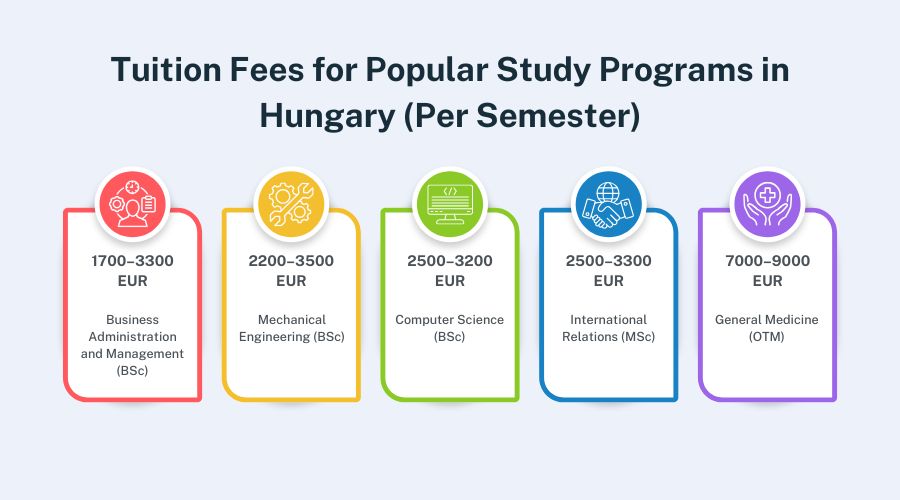
While tuition fees vary based on the institution and program, they remain highly competitive. For instance:

  • Undergraduate programs range from €2,000–€7,000 per year.
  • Master’s programs cost between €3,000–€8,000 per year.

Hungary also offers numerous scholarships for international students, including the prestigious Stipendium Hungaricum. This scholarship covers full tuition, accommodation, health insurance, and a monthly stipend, making it an excellent opportunity for eligible students.

Funding Options for International Students

Student Loans
For self-financed students, Hungary’s Student Loan Centre offers loans with favorable interest rates. To qualify, students must:

  • Be under 45 years of age.
  • Have a valid student status in Hungary.
  • Meet residency and legal requirements.

Repayment is income-based, beginning only after graduation, ensuring manageable financial commitments.

Student Jobs
International students can work up to:

  • 30 hours per week during term time.
  • 66 working days during breaks.

The minimum monthly wage is approximately €445 for unskilled jobs and €550 for skilled positions, providing additional financial support for living expenses.

What Makes Hungary Unique?

  • Affordable Living: Students can comfortably manage their expenses with an average monthly budget of €500–€700.
  • Rich Cultural Experience: Hungary’s history, architecture, and vibrant student life create an enriching environment for learning and personal growth.
  • Global Recognition: Degrees from Hungarian universities are internationally recognized, opening doors to exciting career opportunities worldwide.

Conclusion

Hungary is the perfect destination for students seeking affordable, high-quality education in a culturally rich and welcoming environment. From renowned universities like the University of Pécs and the University of Szeged to accessible funding options, Hungary ensures that your academic journey is both financially sustainable and academically rewarding.

Are you ready to take the first step towards a brighter future? Explore the opportunities Hungary has to offer and make your dream of studying abroad a reality!
Read More